THE DILEMMA OF NATIONAL SCHOOLS WITH INTERNATIONAL PROGRAMS
Zulfan Haidar Zamzuri Umar
Counselor
Head of Department Guidance and Counseling
International Islamic School IIUM
Cambridge International Exam Center MY102.
Contents:
Introduction: where it all begins
Current Statistic: The blooming schools
Current Problems: Hidden facts-Current dreams
The Identity Crisis: National or International
The Dilemma: Either / or
The Bombshell: Where to go from here
Workable Solutions for future Indonesia:
Introduction:
Where it all begins: UU No. 20, year 2003: Sisdiknas verse 50, article 3: the government intend to develop national schools with an international standard.
The Vision: to produce intelligent students who possess a firm belief in God, good attitude and mannerism, national identity to compete in both national and international arena.
The Mission: to upgrade the national educational services and graduates to an international standard.
The development: this open invitation from the central government has sparked excitement to businessmen and mixed responses to educators and teachers alike.
The fact: no clear guidance and supervision from the government are immediately available leading some schools that embrace the programs to freely interpret the invitation without solid future program for the international graduates.
Current Development and Statistics
Following a national invitation from the government, hundreds of schools start adopting the international curriculums and bringing in foreign teachers and principals.
In 2004 in Jakarta: SMAN 70 and Labschool adopted Cambridge Advance Level, this was followed by SMAN 8, SMAN 21, SMAN 68. Surprisingly, the invitation is not well welcome in Jogjakarta and Bandung---two cities famously known as the “city of learning”.
At the end of 2009: 260 schools have been registered as the having the prestigious status, Sekolah Bertaraf International–100 SMAs, 100 SMPs, and 60 SMKs.
Most popular choices of foreign curriculums: Cambridge International Examination (CIE) and International Baccalaureate (IB). CIE certificate can lead its holders to the world Ivy Leagues of world best universities: Cambridge, Oxford, London in Europe and Harvard, Stanford, MIT, Smithsonian, Yale, Temple and Princeton in USA.
Schools with such curriculums are then asking for tuitions fees equivalent to tuition fees of either masters or doctoral studies or in some extreme cases, masters and doctoral fees combined.
Current problems: Clear and Present Danger
Teachers’ competency: according to a survey it will take 3-7 years of training for teachers to master and deliver the subjects well with proper English skills and competency.
Students’ language proficiency: if it takes 3-7 years for a teachers to master both subject and language, how long it takes for the whole school to absorb and understand the teaching and learning processes.
Fantastic annual tuition fees: Kindergarten USD1200-3000, Primary USD 3800-4100, Secondary USD 4800-5600, excluding development fees, extracurricular and other activities. Sinarmas World Academy asking for this: G1-4 Rp80 millions, G5-6 Rp82 millions, and G7-10 Rp89 millions.
School’s status: these international schools with fantastic tuition fees and school facilities, soon become the “elite few” and are affordable only by “super rich parents.”
The Identity Crisis
Indonesia has make it mandatory for each and every citizen, a national examination in all school level.
This has created a national identity crisis among students who have the intentions to further their studies abroad and holders of either Cambridge O or A level certificates.
Why should international schools make it mandatory for every student to sit for the national examination?
Confusing Dualisms: To be national certificate holders or international holders or both?
The lack of clear briefing from the school authority for both parents and students on this issue will intensify the crisis.
On top of this problem, all national universities only accept students with national examination certificates.
Therefore all Indonesian students who studied abroad and intend to take their degrees in national universities should sit for exam on their own by taking the infamous C package.
The Dilemma: Either / or
Having the freedom to implement the both national and international curriculum and learning from other international schools in the Asean countries leads to the notion of this:
national exam and certificate for students who want to further their studies in national universities;
International exam and certificates for graduates who intend to go to Europe or North America, two popular choices beside Australia and Japan.
The Bombshell: Where to go
It is seems easier to establish National school with international curriculum than to provide its graduates with financial assistant and links to universities / colleges to further their studies.
It will be national waste of time and money if these international graduates are unable to be admitted in prestigious international universities.
Surprisingly, only few elite International Schools in Jakarta have access to direct admission to prestigious universities in Europe and North America and Canada.
Workable Solution for the Future
Since establishing an entirely International Program for the whole school requires tremendous efforts in both teachers and learners it is logical to suggest the followings:
1). Establishing international classes with solid program and creative adaptation of both national and international curriculums.
2). Providing graduates with direct links to international higher institutions (universities/colleges)
3). Providing students a freedom of choice to take either international exam (for international admission) or national exam (national admission)
Concluding Remarks:
Indonesia is making a dangerous move by allowing international curriculum to be freely adapted in the national schools back up by national policy.
Soon or later SBI-National schools with International program will intensify the already widening gap between the elite few and the commoners.
Brilliant graduates of international schools who failed to be admitted in international universities/colleges will become “smart garbage” who will eventually back fire their alma-mater—and the nation as a whole.
Minggu, 14 Februari 2010
From : International Conference on Islamic Education, KL


Minggu, 31 Januari 2010
CAR,it easy..

What is Action Research?
Action Research is a process in which participants examine their own educational practice systematically and carefully using the techniques of research. It is based on the following assumptions:
*teachers and principals work best on problems they have identified for themselves;
*teachers and principals become more effective when encouraged to examine and assess their own work and then consider ways of working differently;
*teachers and principals help each other by working collaboratively;
*working with colleagues helps teachers and principals in their professional development.
Heidi Watts, Antioch Graduate School
What Action Research Is Not
1.It is not the usual things teachers do when they think about their teaching. Action Research is systematic and involves collecting evidence on which to base rigorous reflection.
2.It is not just problem-solving. Action Research involves problem-posing, not just problem-solving. It does not start from a view of problems as pathologies. It is motivated by a quest to improve and understand the world by changing it and learning how to improve it from the effects of the changes made.
3.It is not research on other people. Action Research is research by particular people on their own work to help them improve what they do, including how they work with and for others. Action Research does not treat people as objects. It treats people as autonomous, responsible agents who participate actively in making their own histories by knowing what they are doing.
4.It is not the scientific method applied to teaching. Action Research is not just about hypothesis-testing or about using data to come to conclusions. It is concerned with changing situations, not just interpreting them. It takes the researcher into view. Action Research is a systematically-evolving process of changing both the researcher and the situations in which he or she works. The natural and historical sciences do not have this aim.
Henry and Kemmis
Techniques for Gathering Data
1.Interviews with students, parents, teachers
2.Checklists of skills, behaviors, abilities, movement, procedures, interactions, resources
3.Portfolios of a range of work from students of different abilities around a particular topic; a representation of a total experience; a collection of documents for analysis
4.Individual files of students' work (e.g., tapes, samples of work, art work, memos, photos of models/projects, reports), of students' opinions; of student attitudes, of students' experiences
5.Diaries/journals written by teachers, students, parents, class groups, teachers
6.Field notes/observation records - informal notes written by a teacher
7.Logs of meetings, lessons, excursions, school expectations, material used
8.Student-teacher discussion/interaction - records of comments and thoughts generated by students
9.Questionnaires of attitudes, opinions, preferences, information
10.Audiotapes of meetings, discussions in class or about data gathered, games, group work, interviews, whole class groups, monologues, readings, lectures, demonstrations
11.Videotapes of classrooms, lessons, groups, demonstrations, a day in a school, lunch times
12.Still photography of groups working, classrooms, faces, particular students over time, at fixed intervals in a lesson
13.Time-on-task analysis of students, teachers; over a lesson, a day, a week
14.Case study - a comprehensive picture/study of a student or a group of students
A Process for Analyzing Your Data
In using qualitative research, you will be collecting and analyzing at the same time. These processes inform each other. Be open to new ways of thinking as you learn more from your data.
1. Go through everything you have collected. Make notes as you go.
2. Look for themes, patterns, big ideas. Key words and phrases can trigger themes. Determine these themes by your scan of the data, not on your preconceived ideas of what you think the categories are.
3. Narrow the themes down to something manageable. (3-5 of your most compelling and interesting)
4. Go back through all of your data and code or label information according to the themes in order to organize your ideas. Some ideas may fit into more than one theme. Create sub-groups under each theme.
5. Write continuously. Jot down what you are seeing, what questions are emerging, and what you are learning. Keep notes on those new ideas which are unanticipated. These may be findings or surprises which you had not planned.
6. Review your information after it is coded/labeled to see if there is
*a frequency of certain items and/or
*powerful, interesting, unusual comments or behaviors which are of particular interest to you. This may be an incident which gives you a new insight, and it may be one of the most important to hold on to.
7. Identify the main points which appear most frequently and are the most powerful. It will be hard to let go of some of your information, but it is important to sift through it.
8. Write up your major points. You can write them up by
* theme,
* chronologically, or
* the different modes you used for collecting information.
9.Draw the information together to include some of the evidence which supports each of your themes. The reader should be able to draw conclusions based on the evidence you have presented.
Kamis, 19 November 2009
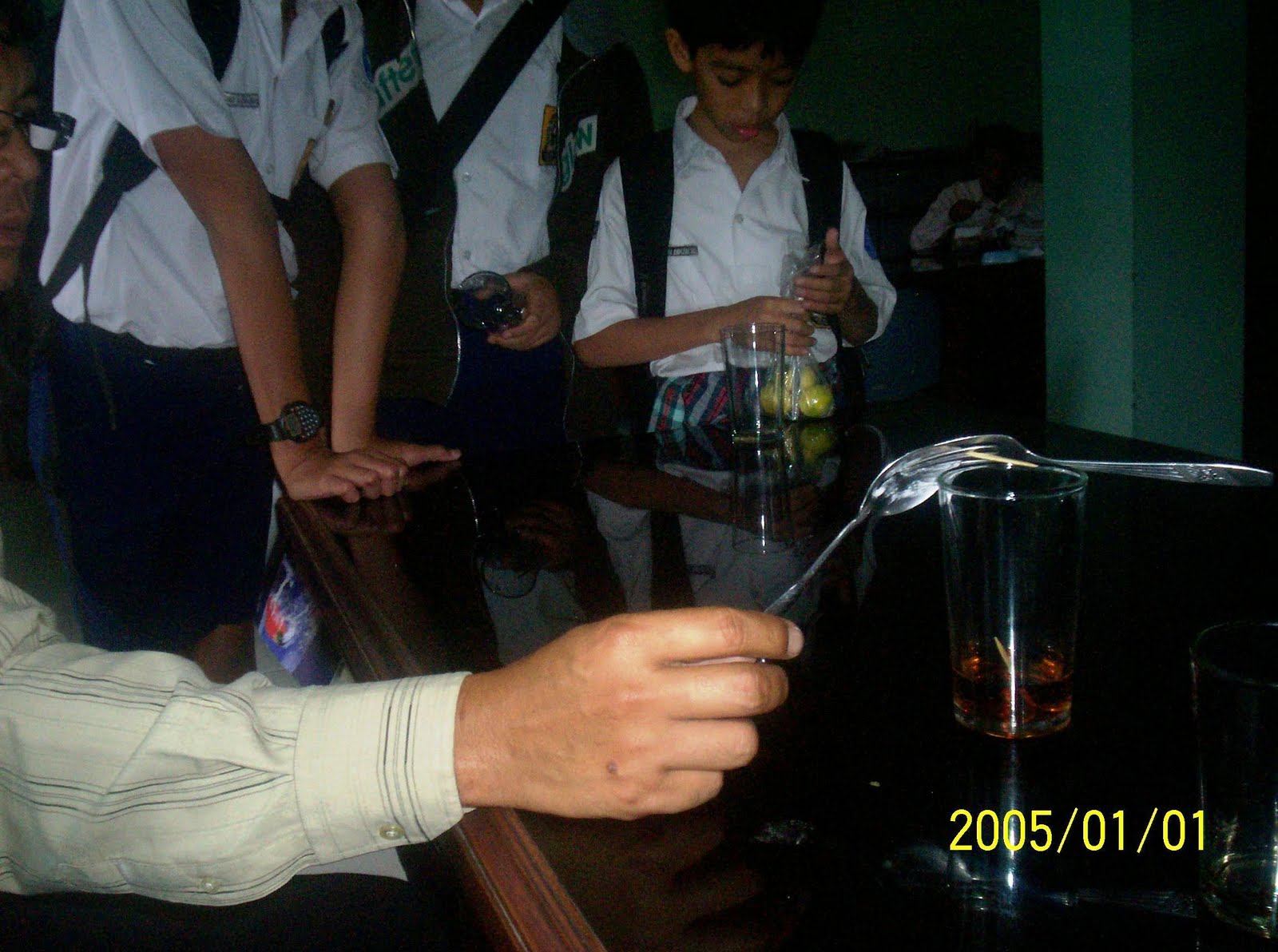
Balancing Moments
Examples of Stability of Objects and Oscillations.
It seems impossible but with some care and patience, this balancing trick can be done. In fact, it is so stable,you can displace it gently and it will even oscillate!




Read More......
Rabu, 11 November 2009
Archimedes Law
 You remember Archimedes. He was a Greek mathematician, famous for all kinds of things, but among the most oft-repeated tales is how he came to the aid of his friend, Hiero, king of the Greek city of Syracuse. Hiero suspected that a goldsmith charged with making him a royal crown -- one assumes he needed a spare -- had kept some of the gold provided for himself, and mixed in silver to ensure the weight of the final crown matched that of the original lump of gold provided. He didn't want to melt the crown down to discover the truth, but the thought just nagged at him, and he asked Archimedes to help. Inspiration hit one day as Archimedes lowered himself into one of the public baths in the city and noticed displaced water flowing over the sides of the tub. Legend has it that he was so excited with his insight, he leapt out of the tub and ran (naked?) through the streets of Syracuse yelling, "Eureka! Eureka!" ("I found it! I found it!")
A theoretical insight must be backed up by experiment, so Archimedes took a lump of gold and of silver, each weighing the same as the king's crown, although the lump of silver was much larger because silver is lighter than gold. He put each lump in a vessel filled to the rim with water, and noted that the larger amount of silver caused more water to overflow than the lump of gold, because there was more material, even though both weighed the same. He concluded that a solid material will push away an amount of water equal to its own bulkiness (volume). So if the king's crown were indeed made of pure gold, it would have to displace the same amount of water as the lump of pure gold that weighed the same. Unfortunately for the dishonest goldsmith, the crown made more water overflow than the pure lump of gold, proving that the goldsmith had added silver to the crown to make it bulkier. The goldsmith's fate was probably not a happy one.
This property is known as buoyancy: an object will float if its buoyancy is greater than its weight, and will sink if its weight is greater than its buoyancy. It must be said that the shape and position of a given object plays a vital role here: a concrete canoe placed on end in water will sink because the weight of the concrete is greater than that of the displaced water. But in its normal position, the weight of the canoe depends on its total volume, and this includes all the air inside it. So the average weight is less than that of the water displaced, and the canoe floats. It's weird, but true, like many counter-intuitive concepts in physics. And let's face it -- it's also pretty cool. (According to Wikipedia, the competition rules allow teams to insert concrete-covered, non-structural foam pieces in their canoes so that the canoes float after being submerged. Hmmm. Seems like a bit of cheat to me.)
Concrete in some form or another dates back to 5600 BC Serbia (Bora! would be so proud), evidenced by the discovery of remnants of a hut with a floor made of red lime, sand and gravel. In China, the pyramids of Shaanxi (thousands of years old) contain a mixture of lime and volcanic ash or clay, and the Assyrians and Babylonians also used clay as cement in their concrete. Builders in the Roman Empire preferred concrete made from quicklime, pozzolanic ash, and an aggregate mad from pumice (similar to modern Portland cement concrete). They also figured out that adding horse hair made concrete less likely to shrink, while adding blood -- you heard me: blood -- made the concrete more frost-resistant. The Egyptians liked to different and opted for lime and gypsum cement -- although in all seriousness, the variations probably had as much to do with available materials in the different regions as anything else.
Read More......
Jumat, 30 Oktober 2009

DC Electric Power
P = VI
Power = Voltage x Current


Read More......
Kamis, 22 Oktober 2009


Jumat, 09 Oktober 2009
Quake Wiped Out Entire Villages
As rescue workers searched for survivors in the wreckage of a four-story school Thursday, Mira Utami's mother clawed away, too - looking for the shoes missing from her daughter's body.
Mira was taking a high school English final when the quake hit, flattening the school in seconds and killing her a week before her 16th birthday.
"We had planned to celebrate ... but she's gone," said her mother, Malina, weeping amid the wreckage where the barefoot body was found.
John Holmes, the U.N.'s humanitarian chief, set the death toll at 1,100, and the number was expected to grow. Government figures put the number of dead at 777, with at least 440 people seriously injured.
Wednesday's 7.6-magnitude earthquake started at sea and quickly rippled through Sumatra, the westernmost island in the Indonesian archipelago.
An eerie quiet settled over Padang late Thursday as workers called off search efforts for the night.
"More than 50 percent of the buildings are collapsed," Padang resident Joseph Tanto told..
Thousands are thought trapped under shattered buildings in the city of 900,000, raising fears of a significantly higher death toll when the debris is cleared.
"Let's not underestimate. Let's be prepared for the worst," President Susilo Bambang Yudhoyono said in the capital, Jakarta, before flying to Padang, a coastal city and West Sumatra province's capital.
At least four Indonesian villages were obliterated by earthquake-triggered landslides that buried as many as 644 people including a wedding party under mountains of mud and debris, officials said Saturday.
The full extent of Wednesday's 7.6-magnitude earthquake was becoming apparent three days later as aid workers and government officials reached remote villages in the hills along Sumatra island's western coast.
If all 644 are confirmed dead - as is likely - the death toll in the disaster would jump to more than 1,300. The government's death toll currently is 715, with most casualties reported from the region's biggest city, Padang, where aid efforts are currently focused.
Rabu, 08 Juli 2009
Charge and Charge Interactions
The Structure of Matter

Perasaan tadi ada listrik elektrostatik dech....
History of Atomic Structure
English scientist J.J. Thomson's cathode ray experiments (end of the 19th century) led to the discovery of the negatively charged electron and the first ideas of the structure of these indivisible atoms. Thomson proposed the Plum Pudding Model, suggesting that an atom's structure resembles the favorite English dessert - plum pudding. The raisins dispersed amidst the plum pudding are analogous to negatively charged electrons immersed in a sea of positive charge.

Bohr's view of quantized energy levels was the precursor to modern quantum mechanical views of the atoms. The mathematical nature of quantum mechanics prohibits a discussion of its details and restricts us to a brief conceptual description of its features. Quantum mechanics suggests that an atom is composed of a variety of subatomic particles. The three main subatomic particles are the proton, electron and neutron. The proton and neutron are the more massive of the three subatomic particles; they are located in the nucleus of the atom, forming the dense core of the atom. The proton is charged positively. The neutron does not possess a charge and is said to be neutral. The protons and neutrons are bound tightly together within the nucleus of the atom. Outside the nucleus are concentric spherical regions of space known as electron shells. The shells are the home of the negatively charged electrons. Each shell is characterized by a distinct energy level. Outer shells have higher energy levels and are characterized as being lower in stability. Electrons in higher energy shells can move down to lower energy shells; this movement is accompanied by the release of energy. Similarly, electrons in lower energy shells can be induced to move to the higher energy outer shells by the addition of energy to the atom. If provided sufficient energy, an electron can be removed from an atom and be freed from its attraction to the nucleus.

This brief excursion into the history of atomic theory leads to some important conclusions about the structure of matter which will be of utmost importance to our study of static electricity. Those conclusions are summarized here:
* An atom consists of a nucleus and a vast region of space outside the nucleus. Electrons are present in the region of space outside the nucleus. They are negatively charged and weakly bound to the atom. Electrons are often removed from and added to an atom by normal everyday occurrences. These occurrences are the focus of this Static Electricity unit of The Physics Classroom.
* The nucleus of the atom contains positively charged protons and neutral neutrons. These protons and neutrons are not removable or perturbable by usual everyday methods. It would require some form of high-energy nuclear occurrence to disturb the nucleus and subsequently dislodge its positively charged protons. These high-energy occurrences are fortunately not an everyday event and they are certainly not the subject of this unit of The Physics Classroom. One sure truth of this unit is that the protons and neutrons will remain within the nucleus of the atom. Electrostatic phenomenon can never be explained by the movement of protons.

A variety of phenomena will be pondered, investigated and explained through the course of this Static Electricity unit. Each phenomenon will be explained using a model of matter described by the above three statements. The phenomena will range from a rubber balloon sticking to a wooden door to the clinging together of clothes which have tumbled in the dryer to the bolt of lightning seen in the evening sky. Each of these phenomenon will be explained in terms of electron movement - both within the atoms and molecules of a material and from the atoms and molecules of one material to those of another. In the next section of Lesson 1 we will explore how electron movement can be used to explain how and why objects acquire an electrostatic charge.
Minggu, 10 Mei 2009
What is stress?

and ourselves in many different ways. Some people get irritable and lose their sense of humour, some withdraw or become obnoxious, others feel fatigued and overwhelmed.
Stress is the body’s response to what is happening in our lives and can take many forms. Some stressful situations in our lives are sudden and diffi cult, others life changing, but most are just part of our everyday life.
With everyday stress, we deal with it along the way and it doesn’t necessarily negatively affect our wellbeing. But it is when the demands of our days exceed our ability to cope that we fi nd ourselves out of balance.
1 Stress reduces our capacity to be productive in all aspects of our lives.
2 It can negatively affect all of our relationships and it can also make us very sick.
3 Unmanaged stress can cause depression, which has been described as the common cold of mental illness.
That’s why we need to take this seriously; to realise that if the pressures of our lives are greater than our capacity to cope, then we need to take responsibility to make the changes in our lives to protect our wellbeing
Read More......
Rabu, 29 April 2009
Global warming
Use your head to cooling down around.........

Global warming is the increase in the average temperature of the Earth's near-surface air and oceans since the mid-twentieth century and its projected continuation. Global surface temperature increased 0.74 ± 0.18 °C (1.33 ± 0.32 °F) during the last century.[1][A] The Intergovernmental Panel on Climate Change (IPCC) concludes that anthropogenic greenhouse gases are responsible for most of the observed temperature increase since the middle of the twentieth century,[1] and that natural phenomena such as solar variation and volcanoes probably had a small warming effect from pre-industrial times to 1950 and a small cooling effect afterward.[2][3] These basic conclusions have been endorsed by more than 40 scientific societies and academies of science,[B] including all of the national academies of science of the major industrialized countries.[4]
Climate model projections summarized in the latest IPCC report indicate that global surface temperature will probably rise a further 1.1 to 6.4 °C (2.0 to 11.5 °F) during the twenty-first century.[1] The uncertainty in this estimate arises from the use of models with differing climate sensitivity, and the use of differing estimates of future greenhouse gas emissions. Some other uncertainties include how warming and related changes will vary from region to region around the globe. Most studies focus on the period up to 2100. However, warming is expected to continue beyond 2100 even if emissions stop, because of the large heat capacity of the oceans and the long lifetime of carbon dioxide in the atmosphere.[5][6]
Increasing global temperature will cause sea levels to rise and will change the amount and pattern of precipitation, probably including expansion of subtropical deserts.[7] The continuing retreat of glaciers, permafrost and sea ice is expected, with the Arctic region being particularly affected. Other likely effects include shrinkage of the Amazon rainforest and Boreal forests, increases in the intensity of extreme weather events, species extinctions and changes in agricultural yields.
Political and public debate continues regarding the appropriate response to global warming. The available options are mitigation to reduce further emissions; adaptation to reduce the damage caused by warming; and, more speculatively, geoengineering to reverse global warming. Most national governments have signed and ratified the Kyoto Protocol aimed at reducing greenhouse gas emissions.
Read More......


